

The famous video conversion stats, checked at the source: which ones hold up, which are shaky, and the three conditions every winning test shares.
Yes, usually, but not by the "80%" you have seen quoted everywhere. The best data says two things: most people would rather watch a short video than read about a product, and the same video converts better when the viewer chooses to play it and watches it in focus. A video helps most when it answers the exact question a buyer has, at the moment they are deciding.
We went back to the original sources behind the most-quoted video conversion statistics. This post shows what each one actually measured, how much weight it can carry, and what that means for where you put your videos.
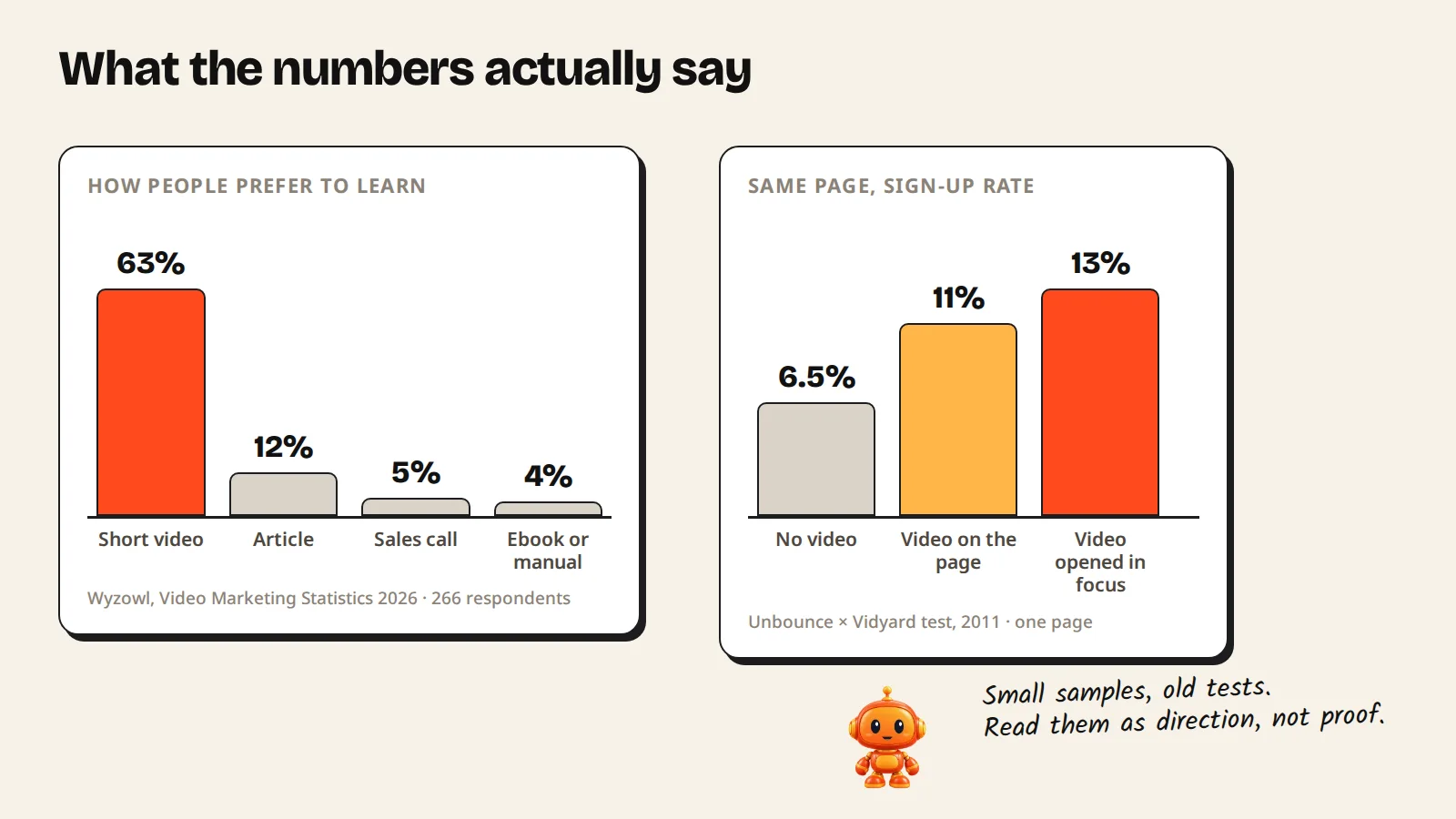
The numbers, checked at the source
1. Most people would rather watch: Wyzowl 2026
Wyzowl has surveyed marketers and consumers about video every year for 12 years. Its 2026 report is based on 266 respondents surveyed in late 2025.
- When asked how they would most like to learn about a product or service, 63% chose a short video. Text articles got 12%, infographics 7%, sales calls 5%, and ebooks, manuals and webinars 4% each.
- 85% of people say they have been convinced to buy a product or service by watching a video.
- 83% of video marketers say video has directly increased sales, and 85% say it has helped them generate leads.
How much it can carry: it is a survey, so it measures what people say, not what they do, and the sample is small. But the gap between video (63%) and reading (12%) is too wide to be noise, and it has held for years.
2. The same video converts better in focus: Unbounce × Vidyard
In a test Unbounce published in 2011, Vidyard ran three versions of its "coming soon" page, built to collect email sign-ups:
| Version | Average sign-up rate |
|---|---|
| No video | 6.5% |
| Video embedded in the page | 11% (+69%) |
| Video opened in a lightbox pop-up | 13% (+100%) |
How much it can carry: one company, one page, an old test, and the post does not report traffic. Still, it is one of the few tests that isolates where the video is shown rather than whether there is one. The same video did better when it had the viewer's full attention.
3. More product pages with video: Liveclicker
Liveclicker, a company that sells video software to retailers, reported in January 2015 that retailers with video on most of their product pages had a 79% higher conversion rate than retailers with video on only a few. The data came from 26 retail clients in one quarter of 2014.
How much it can carry: a vendor's own customers, a small group, and a correlation. Retailers who invest in video may also be better at everything else. Use it as a sign of direction, not as a forecast.
4. The "video lifts landing pages by 80%" claim
This is the most repeated number, usually credited to a study by EyeView. We could not find the original study or how it was measured, and the data is older than 2020. We would not put it in a pitch deck.
What the winning tests have in common
Look past the headline numbers and the same three conditions show up whenever video wins.
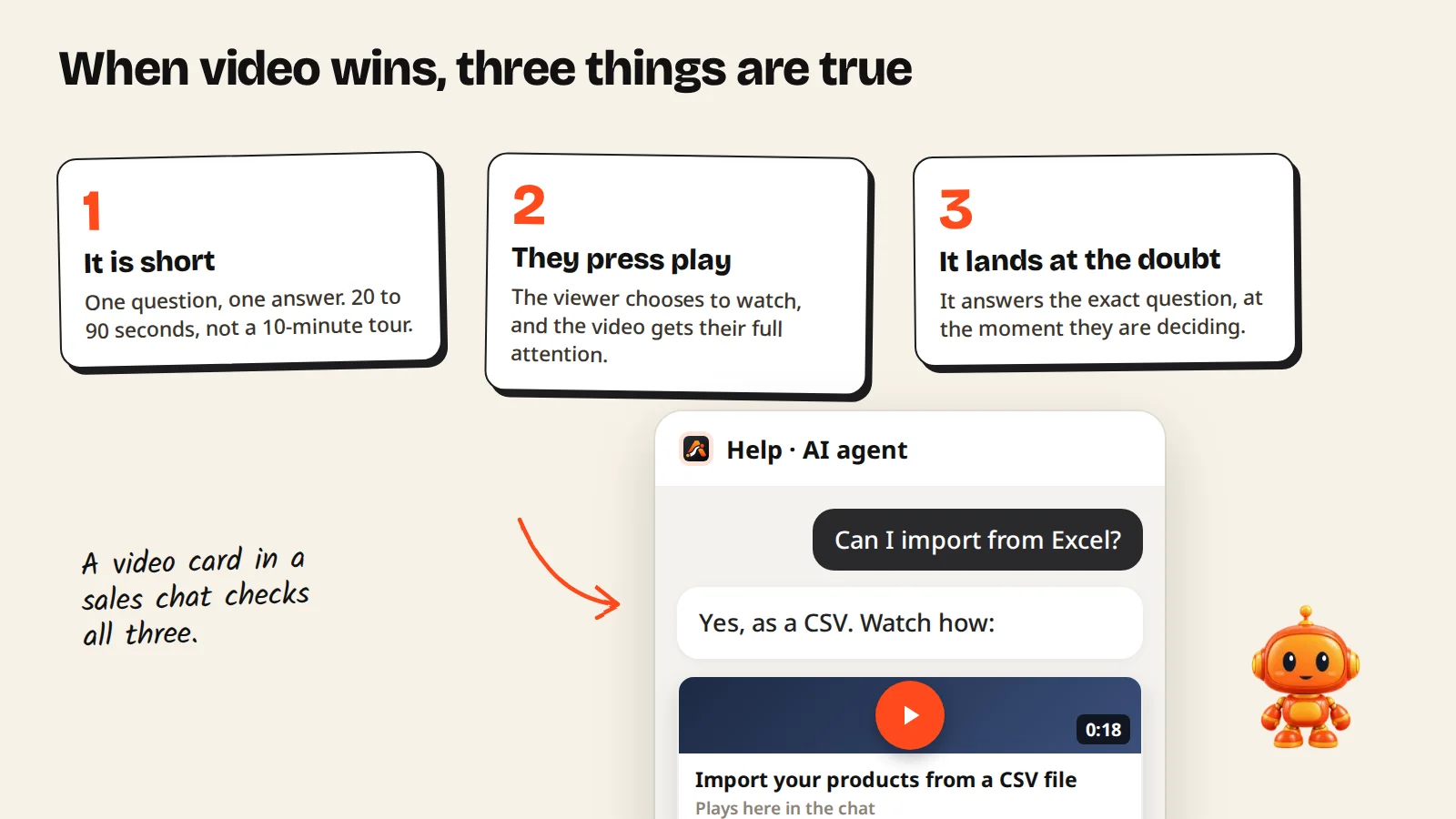
- It is short. In Wyzowl's survey, 71% say videos between 30 seconds and 2 minutes are the most effective. One question, one answer, not a ten-minute tour.
- The viewer presses play and watches in focus. The lightbox beat the embedded video in the Unbounce test. A video someone chose to start, without the rest of the page competing for attention, gets watched.
- It answers the question they have right now. A product page with a video has the video right where the buyer looks at the product. A buyer with a specific doubt ("can it import my data?", "how big is the cabin?") needs the video that answers that doubt, not your general demo.
The common mistake is the opposite of all three: one long product video at the top of the home page, which plays for everyone, whatever they came to find out.
Why a sales chat is a good place for your videos
When a buyer types a question into your chat, they have just told you what is stopping them. That is the moment the third condition needs, and the chat can meet the other two as well:
- One video for one question. With Show your videos on, the AgentGuide Sales agent answers briefly and adds one video card when the buyer wants to see how something works. The card shows the picture, the name and the length.
- The buyer presses play. Nothing autoplays. The video plays inside the chat, so the buyer stays on your page with their question in front of them.
- No video when it doesn't help. A question about price gets the price. The agent picks only from videos you have set to Show to customers, and it doesn't show the same video twice in one conversation.
You can also ask for the click before the buyer types anything. A question in Questions to start a chat that starts with ▶, like "▶ Watch how to set up", gets a play icon and is listed first, under Watch.
Setup takes a few minutes and is covered in Let your AI sales agent play the right video in chat, with use cases for software, online stores and tours. Full steps are in the docs.
Don't trust our numbers either: measure your own
Public studies can tell you that video tends to help. They can't tell you which of your videos help your buyers. You can find that out from your own chats:
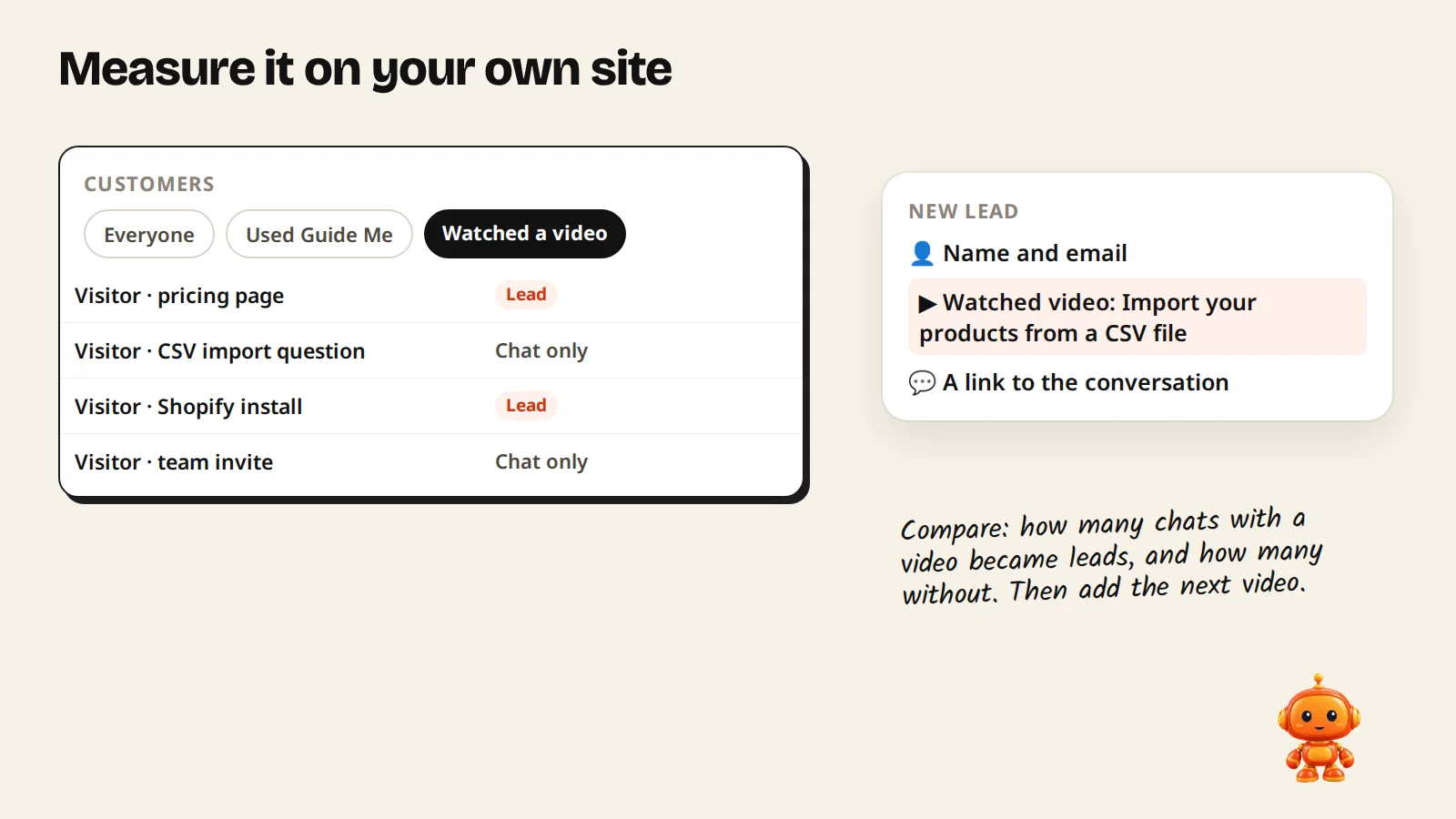
- Start with the questions you already get. In Customers, read the conversations where buyers ask how something works. Make a short video for the top three.
- Let the agent show them for two to four weeks.
- Compare. Under Customers, filter by Watched a video and count how many of those chats became leads. Then count the leads among chats without a video. Every lead from a chat with a video also shows Watched video with the video's name, so your team knows what the buyer has already seen.
- Keep what works. A video that is watched often but never comes before a lead may answer the wrong question. Replace it, keep the name short, and test again.
A small site won't get a statistically clean result in a month. That's fine: you are looking for the video that keeps coming up in the conversations that turn into leads.
Summary
- Video usually helps, but the most-quoted numbers are older, smaller or less clear than they look. Treat them as direction, not proof.
- The better-documented findings agree: people prefer short videos to reading (63% versus 12%), and the same video converts better when it is watched in focus (13% versus 6.5% on one page).
- Video wins when it is short, the viewer chooses to play it, and it answers the question they have at that moment.
- A sales chat meets all three conditions: the agent shows one fitting video when a buyer asks to see something, and every lead records what they watched.
Start free and let your Sales agent show your videos. Show your videos works on every plan, including Free.
Sources
- Wyzowl, Video Marketing Statistics 2026 (266 respondents, late 2025).
- Unbounce, Using Video to Lift Landing Page Conversion Rate by 100% (Michael Litt, October 2011).
- Liveclicker, Video Commerce Report press release (January 2015, 26 retail clients).